Decision Intelligence (DI) is an approach in management and data analytics in which data, analytics, and technology are organized around the goal of helping people make better, faster, and more consistent decisions.
Under the pressure to accelerate decision-making in an increasingly complex business environment, organizations no longer have the luxury of analyzing data before taking action. Instead, Decision Intelligence (DI) is emerging as a foundational mindset that enables organizations to design, operate, and optimize the entire decision-making process.
Unlike traditional approaches where people analyze data and then act, Decision Intelligence starts with defining objectives and designing how decisions should be made, and then uses data to validate and improve them. As a result, data is no longer the starting point, but a tool to ensure decisions are effective and scalable.
Core Components of Decision Intelligence
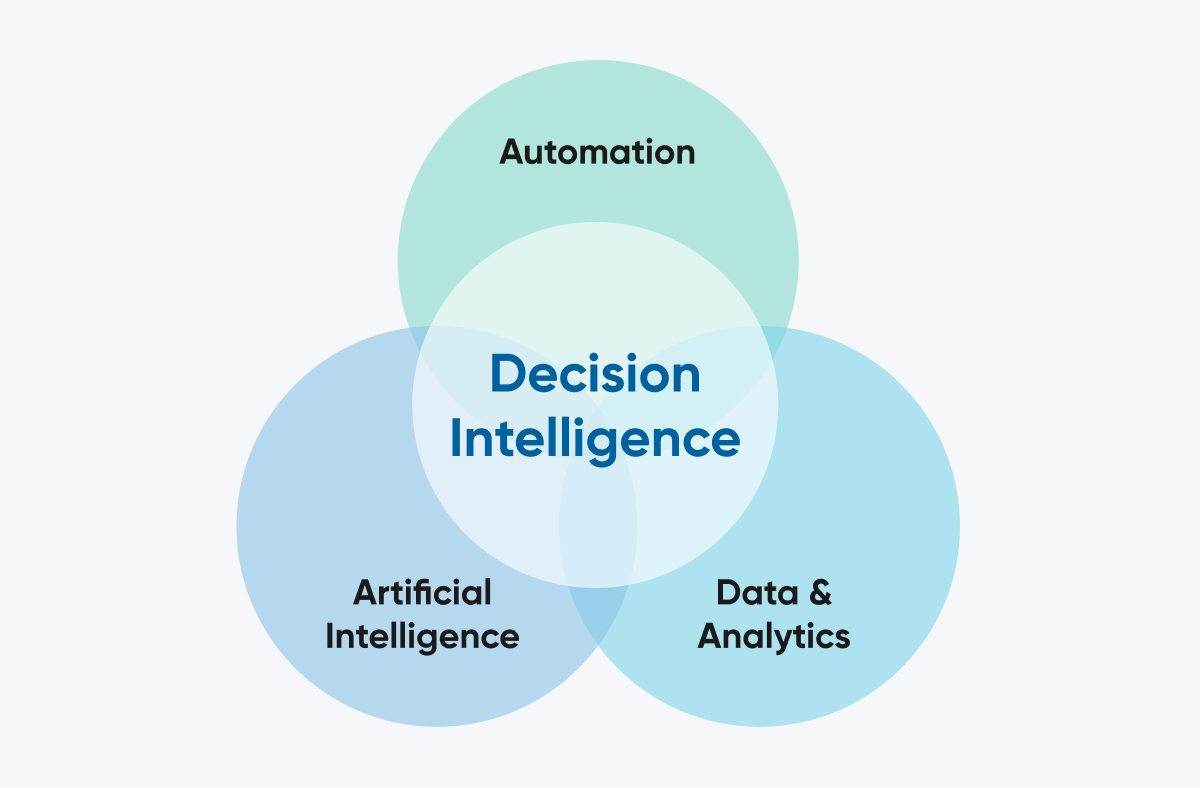
Decision Intelligence is built on the intersection of three key elements: data & analytics, artificial intelligence (AI), and automation. This combination enables organizations not only to understand what is happening, but also to determine what actions to take and how to execute them:
- Comprehensive data utilization: DI leverages real-time and historical data, both structured and unstructured, as the foundation for decision-making;
- AI and automation: Applies models, rules, and algorithms to generate recommendations and even automate repetitive decisions;
- Context-aware intelligence: Every decision is made within the context of business goals, constraints, and operating environments;
- Scenario simulation: Enables testing of multiple options to identify the most optimal course of action;
- Continuous learning: Continuously improves decision quality based on real-world outcomes.
Notably, DI redefines the role of humans in the decision-making process. Instead of tools dictating how decisions are made, humans proactively design decision logic and plans before analyzing data. Depending on the level of AI involvement, DI operates across three levels:
- Decision support: AI provides insights and simulations, while humans make the final decisions;
- Decision augmentation: AI delivers recommendations, while humans review, adjust, and approve them;
- Decision automation: AI autonomously makes and executes decisions within predefined boundaries;
- Business Benefits of Decision Intelligence.
Adopting Decision Intelligence goes beyond improving individual decisions – it elevates the entire decision-making system within an organization:
- Leverages comprehensive data and AI to deliver more accurate decisions beyond human judgment alone;
- Automates repetitive decisions and provides real-time recommendations, accelerating operational speed across the organization;
- Simulates multiple scenarios to identify risks early and proactively develop response strategies;
- Aligns data and understanding across teams, ensuring consistent decision-making on a single source of truth;
- Connects decisions across the enterprise and continuously improves outcomes through learning from real-world results.
Business Benefits of Decision Intelligence
Adopting Decision Intelligence not only improves individual decisions but also elevates the entire decision-making system within an organization:
- Leverages comprehensive data and AI to deliver more accurate decisions beyond human judgment;
- Automates repetitive decisions and provides real-time recommendations, accelerating processes across the organization;
- Simulates multiple scenarios to identify risks early and proactively develop effective strategies;
- Aligns data and understanding across teams, ensuring all decisions are based on a unified foundation;
- Connects decisions across the enterprise and continuously improves outcomes by learning from real-world results.
In a context where speed and scale are critical, Decision Intelligence is not just a technology trend but a shift in management thinking. By designing and optimizing how decisions are made, organizations can move beyond simply reacting to data and start proactively shaping business outcomes.